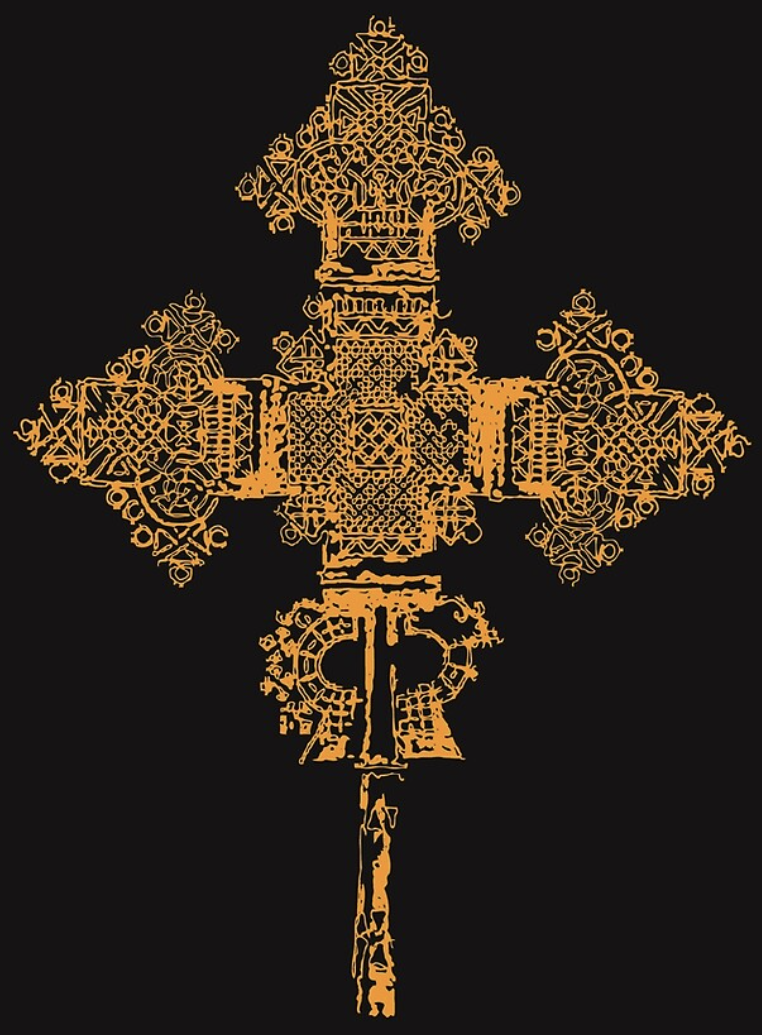
The Ethiopian Orthodox Tewahedo Church
Meet the Church, her worship, her apostolic roots, and why this is the natural place to begin.
Quick view
Progress
Lesson 1 of 22
The Establishment of the Ethiopian Church
By Professor Sergew Hable Selassie
1. Pre-Christian Times
Traditional Sources
According to traditional sources, paganism as well as Judaism were practiced side by side in Ethiopia before the introduction of Christianity. Both were the result of contact with Middle Eastern countries through commercial channels. It is believed that at an early stage of Ethiopian history, the worship of the serpent was widespread and the Ethiopians offered sacrifices to it. This is confirmed to some extent by archaeological evidence found at Axum: on one of the stelae at Axum an engraving of a serpent is still visible today. Though the worship of the serpent was spread through almost all the countries of the Middle East, we have reason to believe that this cult was introduced directly to Ethiopia from Persia. The description in Avesta, the sacred book of Persia, concerning the worship of the serpent, is identical with the tradition found in Ethiopia.
Archaeological Sources
The Sabaean migrants who crossed the Red Sea in the first millennium B.C. and settled in Ethiopia brought with them their own religion. They were polytheists, and worshipped different gods of heaven, the earth and the sea. Almouqah, for example, was the principal god of the south Arabian pantheon, and was retained as such in Ethiopia. Other Sabaean gods, like Astar corresponding to Aphrodite and Venus of the Greek and Roman world, Sin the moon god, and Shams the sun god, were widely worshipped in Ethiopia. Later, with the introduction of Greek culture into Ethiopia, worship of the Greek pantheon became widespread. In the well-known Greek inscription left at Adulis by an anonymous Ethiopian Emperor, mention is made of Zeus, Poseidon and Ares. On the reverse of the monument appear engravings of Hermes and Hercules. Ares was in fact the personal god of the Ethiopian Emperors of the pre-Christian era, as shown in the frequent references made to him in epigraphic inscriptions.
After the third century, with the development of a more purely Ethiopian civilization, Ethiopic names evolved for the gods then worshipped. This can be observed in the pre-Christian Ge'ez inscriptions of Emperor Ezana, where Ethiopic names replace the Sabaean or Greek names. Mahrem corresponds to Ares, Baher to Poseidon, and Astar to the Sabaean god Almouqah.
Temples, altars and statues were dedicated to gods. In Yeha there is a well-preserved temple dedicated to Almouqah. This temple was created before the fifth century; it is rectangular in form with a double wall and single door. A similar temple to the same god existed at Hawlti-Melazo, near Axum, but it is now in ruins. A temple dedicated to Ares is found in Axum itself. Altars to the gods were also erected in various places. For example, at Kaskasse about eight kilometers northeast of Matara, there is an altar with a Sabaean dedicatory inscription to god Sin, engraved with the symbols of the crescent and disc. There are also many altars bearing dedications in Sabaean to Almouqah. After his victory over the Beja people on the northern frontier of his domain, Emperor Ezana erected statues in gold, silver and bronze to the god Ares.
Monotheism
Information about the introduction of Judaism into Ethiopia is found in the Kebra Negest, The Glory of the Kings. The visit of the Queen of Sheba to King Solomon in Jerusalem is recounted there. On her return to Ethiopia she had borne him a son, whom she named Menelik. When Menelik grew up he visited his father in Jerusalem, and came home accompanied by many Israelites, the sons of Levites, bringing with him the Ark of the Covenant, which he had obtained by subterfuge. From then on, Judaism was practiced in Ethiopia. It is said by some authorities that the Falasha tribes of northern Ethiopia, who practiced a form of Judaism, are descendants of the Israelites. The form of Judaism professed in Ethiopia was apparently a development of a pre-Talmudic type of worship.
The Introduction of Christianity
St. Frumentius and the Conversion of Ezana c. 330 A.D.
Although Christianity became the official religion of the Aksumite kingdom in the fourth century, the religion had been known in Ethiopia since a much earlier time. In the Acts of the Apostles 8:26-40, we are told of a certain eunuch, the treasurer of Queen Candace of Ethiopia, who went to Jerusalem to worship the God of Israel. There he met Philip the Deacon and was baptized by him. Ethiopian tradition asserts that he returned home and evangelized the people. In his Homily on Pentecost, St. John Chrysostom mentions that the Ethiopians were present in the Holy City on the day of Pentecost. Later, when the Apostles went out to preach the Gospel, Matthew was allotted the task of carrying the good news to Ethiopia, where he suffered martyrdom. Ethiopian sources, such as the Synaxarium, make no mention of this, however; on the contrary, Ethiopians believe that they received Christianity without shedding apostolic blood. Nevertheless, Christianity was certainly known in Ethiopia before the time of Frumentius, being the faith practiced by many of the merchants from the Roman Empire settled in the Aksumite region. In important cities, such as Axum and Adulis, these Christian merchants had their prayer houses and openly practiced their religion.
The introduction of Christianity as the state religion of Ethiopia came about not as the result of organized evangelical activity from outside the country, but because it was the desire of the king. The story of the conversion of the Axumites has come down to us in the work of the contemporary Church historian Rufinus. Meropius, a philosopher from Tyre, set out to visit India accompanied by two young relatives, Frumentius and Aedesius. Apparently they followed the usual itinerary of the time along the African coast of the Red Sea. In the course of their journey they ran short of provisions and put in at a port of the African coast. The local inhabitants, however, were hostile to Roman citizens, and they massacred Meropius and all aboard the ship, sparing only the two boys, who were taken to the king.
They soon gained his interest and won his confidence. The younger, Aedesius, he made his cup-bearer, while the elder, Frumentius, who showed signs of wisdom and maturity, became his treasurer and secretary. The king died early, leaving his wife with an infant son as heir to the throne. Now the dying king had given Frumentius and Aedesius leave to return to their own country if they so wished, but the Queen Mother who was left as regent begged them to remain to help her administer the kingdom until her son should grow up. The young men agreed, and stayed to carry out the task faithfully.
The thought of Frumentius then began to turn toward matters of faith. He sought out Christians among the Roman merchants settled at Axum, and encouraged them to establish meeting-places for prayer, helping them in every way he could, according them favors and benefits, and gradually spreading the seed of Christianity among the people. The young king himself became a convert. When he was old enough to rule the country alone, Frumentius and Aedesius asked him for permission to leave Axum. Aedesius returned home to Tyre, but Frumentius went to Alexandria and laid the whole affair before the newly appointed Patriarch Athanasius, begging him to appoint a bishop to minister to the needs of the growing Christian community at Axum. The patriarch summoned a council of priests to consider the matter. It was agreed that Frumentius himself should be consecrated as the first Bishop of Axum. Thus he returned to propagate the faith in the land he knew so well.
A letter from the Emperor Constantius, written in 356 A.D. to Aezana and Saezana, rulers of Axum, concerns Bishop Frumentius. Furthermore, the inscriptions and coins of Emperor Ezana testify to his adoption of Christianity. In his earlier inscriptions he styles himself Son of unconquered Mahrem, but in the inscriptions after his victory over Nubia he employed a new terminology, speaking of the Lord of heaven and earth, and describing how he had destroyed the images in their temples, thus affirming his dissociation from paganism. A recently discovered Greek inscription belonging to Ezana leaves no doubt on this matter. It begins: in the faith of God and the power of the Father, the Son and the Holy Ghost. Likewise, the coins minted in the early part of Ezana’s reign bear the pagan symbol of the crescent and disc, while those minted in the later part of his reign bear the sign of the cross.
The introduction of Christianity as the state religion marked a turning point in Ethiopian history. Christianity does not constitute a purely religious phenomenon in the country, but plays an integral role in all aspects of national life. The Church is not only a religious institution, but has for many centuries been the repository of the cultural, political and social life of the people. The true feeling of the people who first received Christianity seems to have been expressed in the names they bestowed upon Frumentius, which are Abba Salama, Kassate Berhan, Father of Peace and Revealer of Light. It is interesting to note that Ezana and Saezana appear to have been baptized with names also signifying illumination: Abreha and Atsbeha.
In Ethiopia, the diffusion of Christianity did not follow the same pattern as in the Graeco-Roman world, where Christianity was confined to the lower levels of society for three centuries and utterly rejected by the ruling classes. In Ethiopia the converse was true. Christianity was introduced first into the royal court, and from there gradually penetrated among the common people. Likewise, in the Roman Empire, the Apostles and later the Church Fathers were actively engaged in the evangelization of the people; in Ethiopia, Christianity was voluntarily adopted.
The birth of the Ethiopian Church took place at a time when the Arian heresy was at its peak. When Frumentius was consecrated, the Patriarchate of Alexandria under the leadership of Athanasius, the Column of Orthodoxy, was the stronghold of the Nicene faith against Arianism. Ethiopia stood by Athanasius and the Nicene faith. In vain, Constantius tried to bring Ethiopia over to the heresy of Arius. A certain Theophilus, a priest from Socotra, highly respected for his impeccable moral character, was entrusted with this mission to Axum, but he was apparently not even allowed to enter Aksumite territory. His mission failed, and Frumentius remained in Axum, to continue the teaching which he had learned from Athanasius.
Expansion and Consolidation of Christianity c. 350 to 650 A.D.
According to the chronological lists of the Ethiopian bishops, Frumentius was succeeded by Bishop Minas. From this time onward began the peculiar Alexandrian jurisdiction over the Ethiopian Church, which was to last for sixteen hundred years. Throughout this period Ethiopians were not considered to be eligible for consecration as bishops. Minas left certain literary works concerning his missionary activities, but the major contribution in the missionary field was that of the Nine Saints.
They came to Axum about 480, and were well received by the emperor Ella Amida and by the inhabitants of the city. The most outstanding figures among the Nine Saints were Za-Mikael Aregawi, Pantalewon, Afse, and Garima or Isaac. As their names indicate, they came from different parts of the Eastern Roman Empire, such as Constantinople and Syria. They were anti-Chalcedonian and seem to have left the countries of their origin because of religious differences. They went first to Egypt and lived some years at the monastery founded by Pachomius before proceeding to Ethiopia.
In Axum they studied the language and became familiar with the people and customs. After this preparation they set out in different directions to proselytize and to introduce monastic institutions. Only two of them, Abba Libanos and Abba Pantalewon, remained near Axum itself; the others went further east of the capital and founded hermitages in the old pagan centers. Za-Mikael went to Debra Damo where the worship of the serpent had long flourished. He succeeded in eradicating the cult and founded a monastery there. Abba Pantalewon transformed a pagan temple into a church. Abba Afse went to Yeha, the renowned Sabaean center, and likewise transformed the famous temple there into a church.
The Nine Saints also contributed greatly to the development of the Ge'ez liturgy and literature. They introduced terms and vocabulary into Ge'ez, such as haymanot, religion; qasis, priest; and ta'ot, idols. But their major contribution was undoubtedly their great work of Biblical translation into Ge'ez. The work of translation had begun in part during the time of Frumentius, but the Nine Saints undertook the massive task of translating the whole Bible. Since they were familiar with both Syriac and Greek, they used a Syrio-Greek text for this purpose.
The Nine Saints also translated a number of basic religious works into Ge'ez. These are of both doctrinal and literary content. Under the title of Qerllos were translated dogmatical treatises and homilies of the Church Fathers, in particular the work known as De Recta Fide by St. Cyril, Patriarch of Alexandria. On this book, which was translated from the Greek text, is based the teaching of the Ethiopian Church. Other works translated at this period include The Ascetic Rules of Pachomius and the Life of Saint Anthony by St. Athanasius.
Music and Art
The coming of the Nine Saints inaugurated a new era in the liturgical life of the Ethiopian Church and in cultural development in general. Music and art flourished. To Yared, an Aksumite scholar of the time, is attributed the creation of Ethiopian church music. He was a disciple of the Nine Saints and composed music in three modes, which is still used in the Ethiopian Church.
Church Organization
After the expansion of Christianity there were at least four dioceses in Ethiopia, each headed by a bishop. The chief of these was obviously the metropolitan of Axum. The second most important diocese was Adulis; it was through this ancient port that Christianity was first introduced to Ethiopia. All the bishops were of Egyptian origin. Thus, an Egyptian bishop always remained at the head of the Ethiopian Church from its foundation up to the second half of the twentieth century, which is a unique phenomenon in the history of the Christian Church.
Persecution and Religious Controversies
Professor Tadesse Tamerat
After the reign of Zar'a Ya'iqob and his immediate successor Ba'ida-Maryam, the Christian kingdom of Ethiopia had a series of minor kings who were too young to take the affairs of state in their own hands. This brought some of the more ambitious royal officials into temporary prominence as guardians of the crown, but these officials had numerous rivals for power, and the whole kingdom entered into a period of political conflicts and civil war which lasted for about fifty years. The end result was the gradual weakening of the Christian army and the slackening of the frontier defense system.
The Wars of Ahmad Gragn
With the Ottoman conquest of the whole Near and Middle East, Islam was given a special impetus in the Red Sea area and in the Horn. The Muslim communities of the Ethiopian region began to be more and more aggressive particularly in their relations with the Christian Empire. Many Turkish and Arab mercenaries came over from across the Red Sea, better equipped with the superior arms of the Ottoman Empire. The Muslim invasion of the Ethiopian highlands in the beginning of the sixteenth century was thus a tremendous success.
The leader of the Muslim forces during this conflict was Imam Ahmad Ibn Ibrahim, or Gragn, as he is known in Ethiopian chronicles. His Chronicle, entitled Futuh al-Habasha, relates how the Muslim invasion was particularly aimed at destroying the Church in the Ethiopian highlands. As the center of the mediaeval Christian culture of Ethiopia and as the place where the kings also kept their fabulous treasures, the Church was attacked by the Muslim forces with particular fury. For a period of about fifteen years, the Muslim troops burnt and looted and almost completely destroyed the mediaeval heritage of Christian Ethiopia.
Many of the inhabitants in the Muslim-occupied areas were forced to renounce the Church and adopt Islam. Although some chose to die for their faith, the large majority of the Christian peasants acquiesced to at least a nominal acceptance of Islam.
The Dilemma in Ethiopian Relations with Europe
The Ethiopian kingdom was later restored after the death of Ahmad Gragn and after the defeat of his army by Emperor Galawdewos, who was given effective military assistance by the Portuguese. The Ethiopians were impressed by reports of the technical advances in Europe and wanted to share in this material civilization. But outside these cultural and diplomatic contacts, a completely different interest preoccupied the Europeans: the religious position of Ethiopia and the extent of its commitment to the Church of St. Mark.
This caused a lot of unnecessary bloodshed in the first part of the seventeenth century, and led to the expulsion of the Jesuit mission by Emperor Fasiladas in 1632. The Jesuit experience was very bitter for the Ethiopian Church and naturally led to the creation of very strong antipathies toward anything European for a long time. Immediately after the official expulsion of the Jesuit mission, there was a very long period of intensive doctrinal controversies within the Church which lasted for over two centuries.
The Period of Reorganization
Professor Sergew Hable Selassie
Tewodros and his religious policy 1855-1868
After the death of Abuna Qerillos about 1828, Ethiopia remained without a bishop until the appointment of Abuna Salama in 1841. The new bishop was a young, energetic man who had attended a Protestant college in Cairo. In Ethiopia, many problems awaited the young prelate, the chief among them being the political instability of the country, widespread doctrinal controversies within the Church, and the activities of foreign missionaries.
After his coronation by Abuna Salama in 1855, Emperor Tewodros II set out to reunite the divided kingdom and to restore Ethiopia to her ancient glory. A fundamental aim of his policy was to put an end to religious controversy in the Empire and to consolidate the Orthodox faith. To this end, in 1855, he imposed the Tewahido doctrine, propagated by Abuna Salama, as the sole doctrine to be allowed in Ethiopia.
At the beginning of his reign, Tewodros showed deep religious faith and strict adherence to Christian moral standards. Many followed his example and began to lead a good Christian life. In the sphere of missionaries' work, Tewodros strongly supported the monks who devoted their lives to evangelizing the pagan inhabitants of the country. Many people, including numerous Muslims, became voluntary converts to Christianity.
The expansion of the Church 1872-1913
In the last years of the nineteenth century the Church of Ethiopia was engaged in consolidation and missionary activities. Emperor Yohannes and King Menelik of Shoa called a council at Boru Meda in Wollo in 1878 in which many learned scholars of the Church participated. The Tewahido teaching was confirmed as the official teaching of the Church.
In southern, western and eastern Ethiopia, missionary work was encouraged by Menelik II and many churches were built in different areas, which had become cut off from the Christian heartland of Ethiopia during the period of conflict. The reintegration into the empire of these regions by Menelik revealed the ruins of many churches in addition to numerous ecclesiastical objects, evidence that these regions were once Christian.
Autonomy 1926-1951
At the dawn of the twentieth century, a new wave of independence arose in the Ethiopian Church. Ethiopians recognized the futility of the canon which prevented them from being prelates in their own country. It was strongly felt that reform and modernization of the Church could not be achieved by a foreign hierarchy out of touch with national life and problems. Matters came to a head in 1926 with the death of Abuna Mattewos, the last of the four bishops who had been appointed in 1881.
During the period of Italian occupation from 1935 to 1941, the Ethiopian Church went through a very difficult period. Italian policy was aimed at undermining the immense influence wielded by the Church as a factor of Ethiopian unity. Abuna Petros and Abuna Michael paid with their lives for their steadfast patriotism and devotion to the Church. The great monks of Debra Libanos were massacred in 1937 and other ecclesiastics suspected of sympathy with the national resistance movement were likewise martyred.
After the liberation of Ethiopia in 1941, negotiations were resumed between the Ethiopian Church and the See of St. Mark. After lengthy negotiations, agreement was finally reached in 1948. Upon the death of Abuna Qerillos in 1951, Abuna Basilios was chosen as Metropolitan of Ethiopia by clergy and laity and thus the full autonomy of the Ethiopian Church was established.
Ecumenism
The Ethiopian Church became a founding member of the World Council of Churches in 1948. The Ethiopian Church participated as an observer in the Vatican Council and was represented at all its sessions. The Ethiopian Church also took part in Pan-Orthodox and Oriental Orthodox meetings, seeking dialogue while preserving and strengthening its own ancient inheritance.
Source
Written by Professor Sergew Hable Selassie and Professor Tadesse Tamerat, The Church of Ethiopia: A Panorama of History and Spiritual Life, Addis Ababa, December 1970. A publication of the Ethiopian Orthodox Tewahedo Church.
Lesson 1 of 22. Pass the lesson check with at least 85% to continue.
The next lesson is locked until you pass the question and answer check.
Focus
The Ethiopian Orthodox Tewahedo Church